Cymbot strikes like a professional drummer
Based on slow-motion footage of a professional drummer, Cymbot's two-axis striker arm uses a cable drive and spring return for quiet, natural rebound.
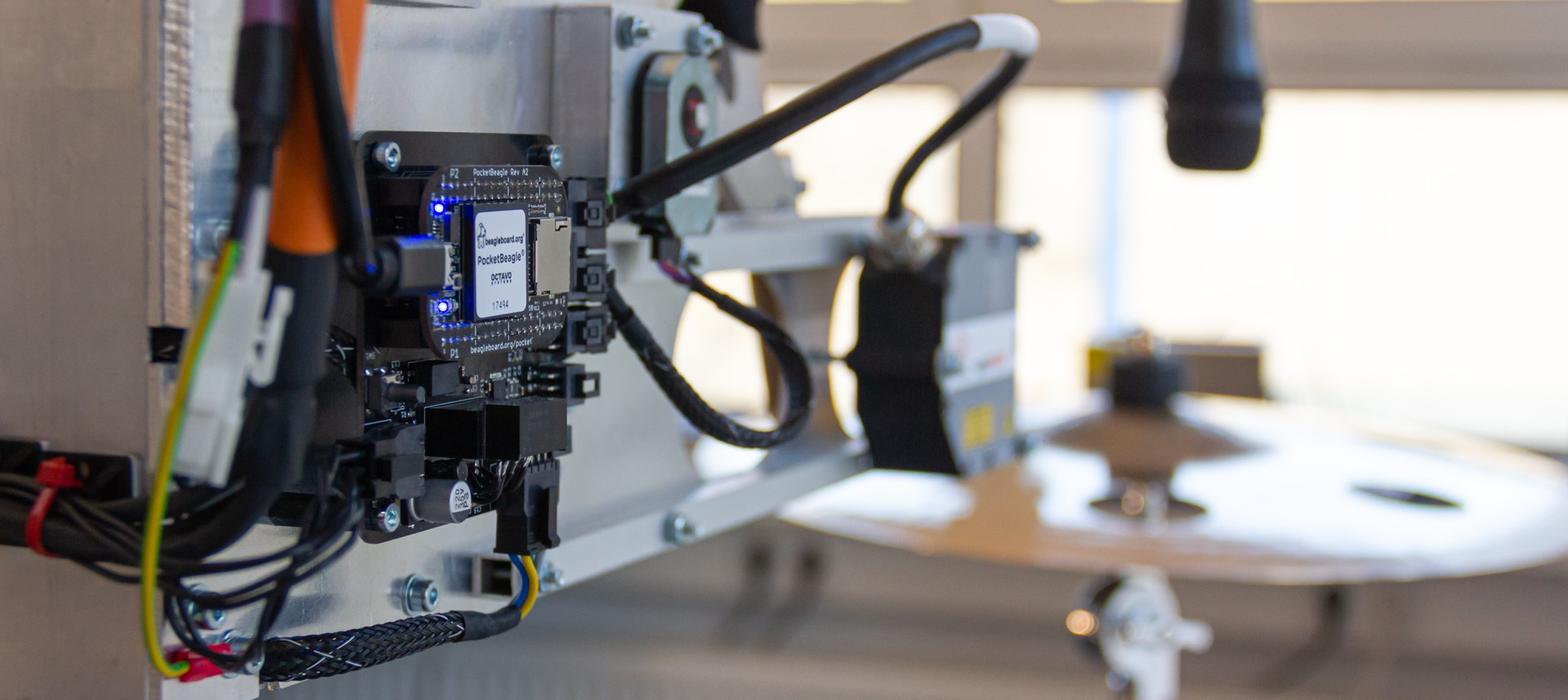
Cymbot creates 100% comparable cymbal sounds through a fully automated calibration process. A web application lets customers of thomann GmbH compare the sounds of different cymbals and make an informed purchase decision.
When choosing cymbals from the Thomann online store, customers can listen to audio samples before making a purchase. Previously, a musician recorded these samples manually. But striking force, angle, motion and position all play a crucial role in making different cymbals comparable. People cannot reproduce these factors with sufficient consistency.
A machine could strike two cymbals in exactly the same way and make them comparable, but that would miss the real objective: providing sound samples that replicate a drummer's playing as closely as possible.
To meet this requirement, the engineers at feinarbyte GmbH first used slow-motion footage to analyze the precise movements of a professional musician. They then developed a striker arm that closely replicates the musician's motion, especially at the moment the stick contacts the cymbal. The result is a relatively complex, freely swinging two-axis striker arm with a cable drive and spring return.
This custom design was necessary for the following reasons:
- The cable drive, the arm's ability to swing freely under its own inertia and the spring return produce a very quiet motion that cannot be heard in the recording.
- Because the stick rebounds differently depending on the cymbal and striking position, it must be free to move away from the cymbal at different speeds. This prevents it from damping the cymbal after impact.
- The arm's two-axis design is modeled on a human arm with an elbow and wrist. It produces a slight sweeping motion when the stick contacts the cymbal, which is essential for a natural-sounding strike.
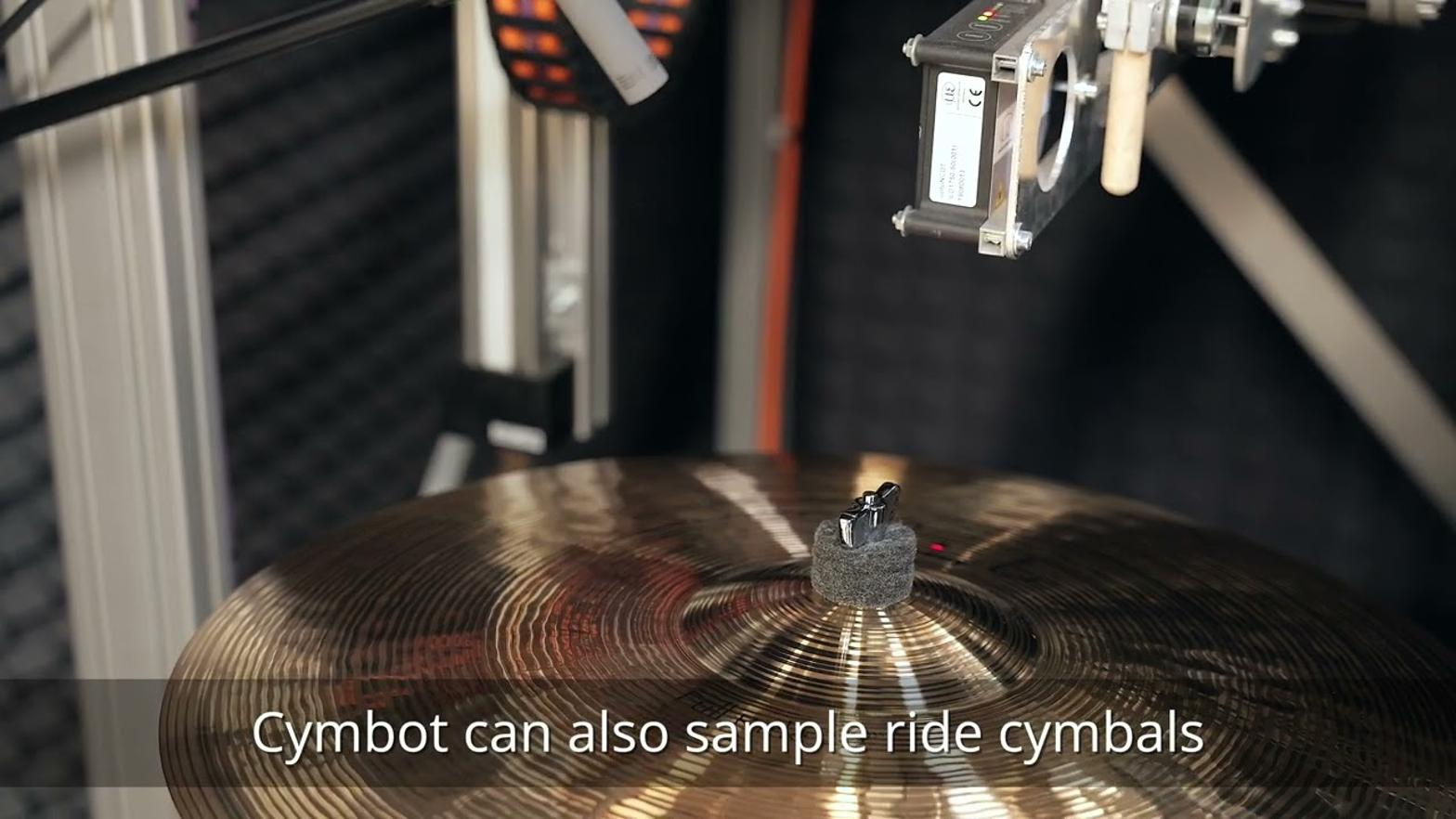
To strike selected points in exactly the same way, the system must know the cymbal's profile and position before recording. Because standardized manufacturer data is not available, each cymbal is measured before the session. Mechanical probes were ruled out because the cymbal is suspended loosely, as were inductive and capacitive measurement systems. The solution is a Micro-Epsilon laser sensor that scans the surface using a three-axis gantry system.
What initially appeared to be a relatively simple task presented several additional challenges, all of which were solved with clever engineering. The machine is a great example of a mechatronic system developed entirely in-house at feinarbyte.
 gearnews.com
 rbtx.de